
Tooth extraction · Gentle care · Melbourne
A careful plan.
A comfortable approach.
Support beyond removal.
Being told a tooth may need to come out can raise questions about comfort, your smile and what happens next. We take time to explain the options and plan the whole journey with you.
At Enhance Dental, Dr Joseph Paino assesses whether your tooth can be kept. If extraction is the appropriate choice, we discuss gentle treatment, any temporary tooth replacement and whether socket preservation could help your future care.
St Kilda Road, Melbourne · Nervous patients welcome · Complex cases referred to OMFS
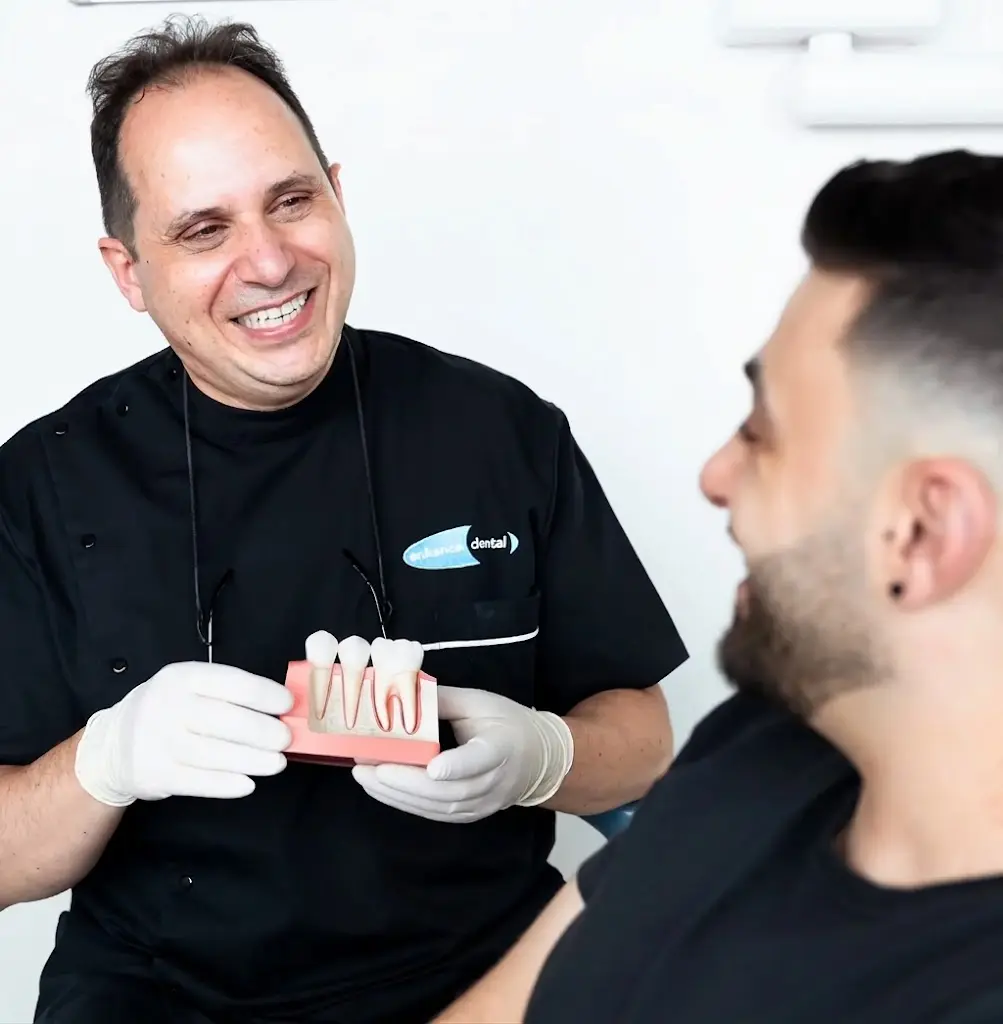
Understand the choice before deciding
Tooth extraction in Melbourne, with an individual assessment
Extraction means removing a tooth from its socket. Our starting point is to assess what is wrong, what can realistically be repaired and how each option fits your health, priorities and longer-term dental care.[1]
Keeping a tooth
Restorative care, root canal treatment or gum treatment may be possible. Sometimes a specialist opinion helps clarify the outlook.
Explore Porcelain Crowns or read about root canal treatment.
When removal may help
Extensive decay, a non-restorable fracture, severe loss of support or infection may make keeping the tooth unreliable. Extraction can also form part of a carefully agreed orthodontic or other treatment plan.
Looking beyond the gap
We assess appearance, biting contacts, neighbouring teeth and your proposed replacement. Not every missing tooth needs replacement; movement or functional problems are possibilities, rather than inevitable consequences.
For impacted third molars, nerve assessment and options specific to those teeth, see our detailed wisdom teeth guide. Routine extraction and wisdom tooth surgery can have different planning needs.
Pain or swelling now?
Call (03) 9533 8488 for advice and assessment. Rapidly spreading swelling or difficulty breathing or swallowing requires emergency care: call 000 or attend an emergency department immediately. Do not wait for an email response.
Plan your smile before extraction day
An immediate denture or clear temporary tooth
If an extraction will leave a visible gap, affect important biting contacts or change the support of remaining teeth, a temporary replacement may be useful. We discuss this before removing the tooth, so a suitable appliance can be ready for the extraction visit where practical.
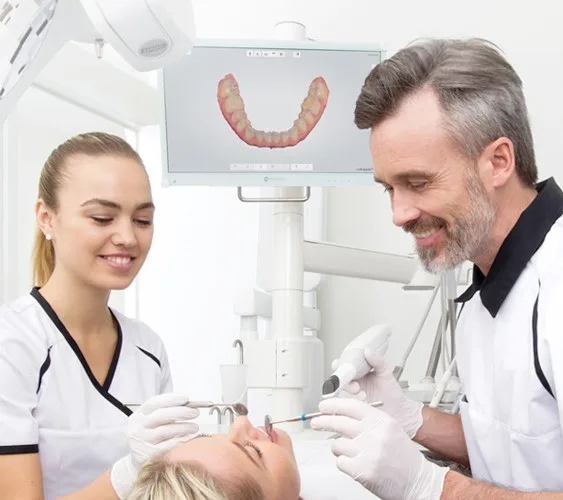
Digital planning with 3Shape TRIOS
We use our 3Shape TRIOS digital scanner to record the visible teeth, gum contours and bite. The laboratory can use these records to plan a replacement before extraction, avoiding gooey impression material in many cases. Additional records or a conventional impression may occasionally still be needed.[20]
Digital immediate-denture workflows have been described in the clinical literature. They support advance planning; they do not make a perfect post-extraction fit automatic, because the tissues change during healing.[5]
A digital scan records surface detail. It is different from an X-ray and cannot show hidden roots or bone. Explore our digital dental technology.
| Option | What it can offer | What to understand |
|---|---|---|
| Immediate partial or full denture | An acrylic replacement for one, several or all teeth in an arch, prepared beforehand and fitted after extraction when appropriate. It can help appearance, speech and selected chewing needs. | Early fit and bite need review. Healing changes often require adjustments, a reline or a later remake. It must be shaped to protect the wound or graft. |
| Clear “suck-down” appliance with a pontic | A thin, custom clear shell carrying a tooth-coloured pontic—an artificial tooth in the gap. Often useful for a short-term front-tooth replacement and, where designed for it, maintaining the planned space. | Mainly a cosmetic temporary option. It is not a definitive chewing tooth, orthodontic treatment or a bruxism splint. We give instructions about removal for meals and cleaning, and ensure it does not press on the healing site. |
Clear retainer-style appliances carrying replacement teeth have a long clinical history, but published technique reports do not establish that they suit every bite or extraction site.[6] An immediate denture likewise needs follow-up as the ridge changes.[7]
Preparation matters
Allow time for scanning, design and fabrication before a planned extraction. Bring any current denture or retainer. We explain the first-day wearing schedule, cleaning and review arrangements for your appliance. If urgent infection needs treatment, we prioritise that care rather than delay it solely to make a temporary tooth.
Preserve options for the future
Socket preservation after tooth extraction
The socket is the space left in the bone after a tooth is removed. During natural healing, the surrounding ridge changes shape and usually becomes narrower. Socket preservation aims to limit this shrinkage by supporting the site while it heals.
For an implant plan
Retaining a useful ridge contour may help later implant planning. Healing and bone assessment still determine the timing; grafting does not guarantee an implant can be placed without additional treatment.
For a bridge or denture
A better-preserved contour may help the shape of the gum beneath a bridge pontic or the foundation for a denture. Evidence is stronger for ridge measurements than for guaranteed improvements in the final prosthesis.
For the right site
We consider socket walls, infection, existing bone loss, your health and the planned replacement. Natural healing, another graft material or specialist treatment may be more suitable.
A Cochrane review found that ridge-preservation procedures may reduce loss of width and height, but certainty was very low and long-term clinical advantages remained unclear.[11] A 2024 review of compromised molar sites also found potential preservation benefits with low to very low certainty; further augmentation could still be needed.[12]
Augma calcium sulfate-based materials
We often use sterile Augma materials when socket grafting is appropriate. These are synthetic mineral-based graft materials used to support bone repair, rather than a replacement tooth or an implant.
3D Bond™ is based on biphasic calcium sulfate. Bond Apatite® combines biphasic calcium sulfate with hydroxyapatite granules. The calcium sulfate has hemihydrate and dihydrate phases; the formulation can be moulded and sets in a moist surgical environment.[8]
The calcium sulfate component resorbs, while hydroxyapatite provides a longer-lasting scaffold. The aim is to support the body’s formation of new bone as the material changes over time. Bond Apatite’s instructions describe an osteoconductive scaffold and sterilisation by gamma irradiation.[9]

What “bone regeneration” means for you
Histological studies examine small tissue samples to see new bone and remaining graft. A small randomised trial involving 33 patients reported less horizontal shrinkage with calcium sulfate/hydroxyapatite grafting than ungrafted healing, and favourable histological findings compared with the bovine graft tested.[10] This is encouraging evidence, not proof of superior results for every patient or every clinical use.
Calcium sulfate has a long history in bone repair. That history should not be read as a century of trials of today’s branded products. A published review discusses the material’s applications and the limits of rapidly resorbing calcium sulfate in larger, poorly contained defects.[13]
Benefits, limits and consent
Socket preservation cannot stop all bone loss or promise a particular percentage of new bone. Graft exposure, material loss, infection, delayed healing or a need for further surgery can occur. We explain the proposed product, alternatives, additional cost and follow-up. The choice to graft is individual, and it is not required for every extraction.
Where infection or a cyst is present, diagnosis and adequate management come first. Grafting may be appropriate immediately in a selected, properly treated site, or delayed. Large defects and uncertain pathology need specialist planning.
Treat the cause and check the diagnosis
Tooth extraction, abscess drainage and cyst removal
An abscess: a collection of pus
An abscess is caused by infection. Care aims to establish drainage and address the source, for example with root canal treatment or extraction when appropriate. Removing a tooth alone is not always the whole treatment plan.[2]
Antibiotics are used when indicated, such as spreading or systemic infection or when prompt local drainage cannot be achieved. They are not a substitute for necessary dental treatment.[3]
A cyst: a tissue-lined cavity
A cyst may be associated with a tooth, but a dark area on an X-ray is not automatically a cyst. Clinical findings, imaging and sometimes a tissue sample are needed. The diagnosis determines treatment and follow-up.[4]
Larger, unusual or complex lesions are referred to OMFS for assessment. Removed tissue may be sent to a pathology laboratory; some cysts require staged treatment and longer review.[15]
What is curettage?
Curettage means carefully removing diseased or inflammatory tissue from the socket or a bony cavity with suitable instruments. Enucleation means removing a cyst lining. These terms describe different parts of treatment; not every socket requires extensive curettage.
When indicated, treatment is carried out with adequate local anaesthetic, with checks that the area is numb. Suitable patients may also have IV conscious sedation. If general anaesthesia or more complex surgery is appropriate, we arrange specialist assessment. We aim for comfortable treatment and stop to reassess any sharp pain; a completely painless procedure or recovery cannot be guaranteed.
A suspected cyst is assessed before grafting or fitting a definitive replacement. Laboratory results and review may change the next step, even if the area initially appears to heal well.
You do not need to feel confident to visit
Gentle tooth extraction, with or without sleep dentistry
Tell us what worries you, how much explanation you prefer and anything that has made previous dental care difficult. We can agree a pause signal, plan breaks and work at a pace you can manage.
If you cannot have or do not want sedation, you are still welcome. A supported appointment while awake may suit you. The tooth, procedure and your health determine what can be safely provided here.
Read about care for nervous patients or explore sleep dentistry.
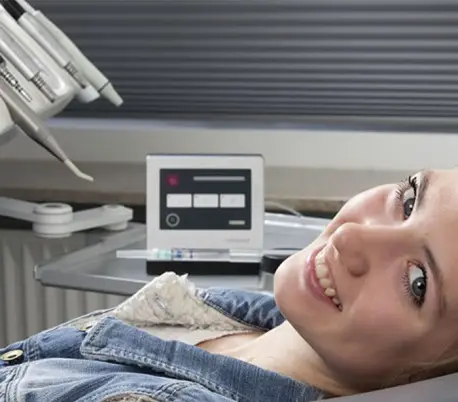
Gentle anaesthetic delivery
Numbing cream where appropriate, CALAJECT computer-controlled delivery, time for the anaesthetic to work and checks before treatment all contribute to our approach.
Jaw and lip comfort
A bite block can support your jaw. Lip balm, comfortable positioning and breaks can help reduce dryness and fatigue. Tell us about jaw joint problems or limited opening.
Controlled techniques
We use techniques suited to the tooth and aim to preserve surrounding tissues. Sectioning a tooth can sometimes aid removal. Pressure, movement and sounds may still be noticed.
| Approach | Experience | Planning |
|---|---|---|
| Local anaesthetic | The area is numbed; you remain awake and can communicate. | Suitable for many extractions, with practical comfort measures and breaks. |
| IV conscious sedation | Medication through a vein helps you feel relaxed and drowsy. You remain able to respond; local anaesthetic is also used. | Can be arranged here for suitable cases with our visiting Dental Sedation Victoria team. Assessment and an adult escort are required.[21] |
| General anaesthesia | You are unconscious under the care of an anaesthetic team in an appropriate facility. | We refer for specialist assessment when GA is considered. The surgeon and anaesthetist advise the setting and preparation. |
Sedation is different from general anaesthesia. Complete sleep or no memory cannot be promised. Follow your treating team’s individual instructions for food, drink, medicines, supervision and driving; do not fast or change medicines based on a general web page.
The right clinician and setting for the case
Referral to OMFS for complex extraction and pathology

We refer suitable patients to the experienced oral and maxillofacial surgeons at OMFS. Their practice includes surgical tooth removal and the assessment and treatment of jaw pathology.[14][15]
Referral may be appropriate for difficult or twisted roots, deeply retained roots, roots close to the sinus or inferior alveolar nerve, a significant cyst or other lesion, medical complexity, or consideration of general anaesthesia.

With your consent, we share relevant imaging, medical information and your treatment concerns. The specialist assesses the options independently, including whether extraction is needed and whether local anaesthetic, sedation or GA is appropriate. Referral does not automatically mean a general anaesthetic.
OMFS surgical tooth removal · OMFS pathology information · Preparing for general anaesthesia
Consultation, surgery, sedation, anaesthetist, pathology and hospital fees may be charged separately. Confirm the actual consultation and surgery locations with the specialist team.
Know what comes next
Your extraction appointment, step by step
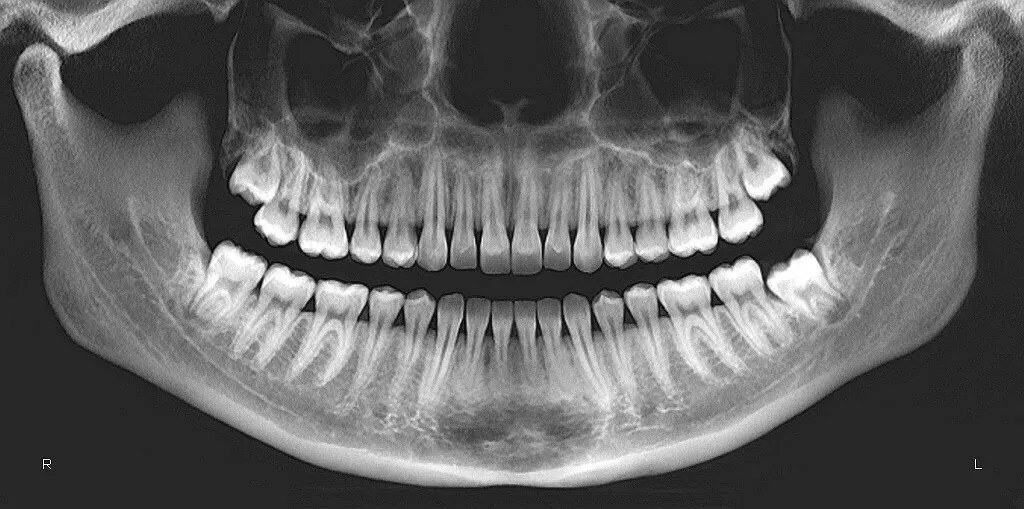
- Assess the tooth and your healthDiscuss symptoms, medicines and alternatives. Review suitable existing radiographs with consent, and take further digital images when justified. A small intraoral X-ray may be sufficient; OPG or selective CBCT is considered when it answers a relevant question.
- Plan the replacement and healingDiscuss temporary teeth, a TRIOS scan, any socket graft and the definitive options. Explain costs, relevant risks and any need for OMFS referral before consent.
- Remove the tooth with appropriate anaesthesiaA simple extraction loosens and removes the tooth. Surgical extraction may need an incision, some bone removal, tooth sectioning or stitches. The technique depends on the findings.
- Check the site and support recoveryManage diseased tissue where indicated, check bleeding control, fit a suitable planned appliance and provide written aftercare and contact arrangements.
Tell us before treatment
Bring an up-to-date medicine list and tell us about allergies, blood thinners, diabetes, immune conditions, previous head or neck radiotherapy, and osteoporosis or cancer medicines such as bisphosphonates or denosumab.
These can affect bleeding, healing or the risk of medication-related osteonecrosis of the jaw. We may coordinate with your doctor or a specialist. Do not stop prescribed medicines yourself; instructions depend on the medicine and procedure.[18][19]
A scan helps assess anatomy but cannot remove every risk. Lower-tooth roots may lie near nerves supplying the lip and chin; upper roots may be close to the sinus.
A clear recovery plan and someone to contact
Recovery after tooth extraction
First day
Protect the socket
Follow the instructions for gauze pressure, rest and bleeding control. Avoid vigorous rinsing, spitting, probing the wound or strenuous activity. Take care not to bite your numb lip or tongue.
Following days
Keep comfortable and clean
Choose suitable soft food and fluids. Gentle cleaning and rinsing may be advised after the first 24 hours. Follow your specific denture or graft instructions and avoid pressure on the healing area.
Following weeks
Review healing and fit
Gum healing and bone remodelling take different amounts of time. Attend the planned review, have sore appliance areas adjusted and agree when the site is ready for the next treatment stage.
Avoid smoking and vaping during healing and follow advice about alcohol and drinking through straws. After surgery, swelling and stiffness can peak around days two to three before improving; the extent of treatment affects recovery.[22]
Pain relief is chosen around your health and medicines. Evidence-based guidance supports non-opioid medicines as the first option when suitable; stronger medicines are not automatically better. Follow your individual advice and check before combining products.[16]
Possible complications and how we help
Dry socket
Clot breakdown can leave painful delayed healing, often becoming more noticeable a few days after extraction. We assess the site and may gently clean it, place a soothing dressing and review pain relief.
Infection or worsening swelling
Increasing swelling, fever, discharge, feeling unwell or reduced opening needs review. Care may include local cleaning, drainage and antibiotics when indicated.
Bleeding
Some blood-stained saliva is expected early. Persistent active bleeding needs firm pressure with supplied gauze as directed and contact with the treating team if it does not settle.
Nerve or sinus complications
Altered lip, chin or tongue sensation can be temporary or persistent. An upper extraction can create a mouth-to-sinus opening. Individual anatomy guides consent and referral.
Nearby teeth or retained fragments
Adjacent teeth or restorations can be affected. A root fragment may occasionally be left deliberately if removal would create greater risk; the clinician explains the decision and follow-up.
Graft or appliance concerns
A graft can become exposed or lose material; an immediate appliance can develop pressure spots or loosen. Contact us rather than adjust the appliance or disturb the socket yourself.
Dry socket is not automatically a bacterial infection, so antibiotics are not usually its treatment. A Cochrane review found that chlorhexidine can probably reduce dry socket in studied settings, mainly wisdom tooth surgery, but suitability and unwanted effects must be considered. We advise whether a mouthwash is appropriate rather than ask everyone to self-start one.[17]
Please contact the treating team if recovery concerns you
Call for bleeding that does not stop with pressure, increasing pain or swelling, fever, discharge, persistent altered sensation or an appliance that is rubbing. For rapidly spreading swelling or breathing or swallowing difficulty, seek emergency care immediately.
If we provided treatment, call Enhance Dental on (03) 9533 8488. If OMFS or another surgeon treated you, follow their postoperative contact instructions; we can help direct you to the right team.
Keep the longer-term plan in view
Replacing a tooth after extraction
| Option | Why consider it? | Planning considerations |
|---|---|---|
| Explore Dental Implants | A fixed replacement supported by an implant in the bone. | Requires assessment of bone, gums, health and maintenance. Immediate placement is suitable only in selected cases; socket preservation is a different procedure. |
| Discover Porcelain Bridges | A fixed replacement supported by suitable adjacent teeth or implants. | Support, bite, cleaning access and the contour beneath the replacement matter. Tooth-supported bridges can require preparation of neighbouring teeth. |
| Partial or full denture | A removable option for one or more missing teeth. | May be immediate or made after healing. Fit changes and ongoing adjustment or replacement should be expected over time. |
| Monitoring without replacement | Appropriate for some gaps after assessing appearance, contacts and function. | Consider possible tooth movement and functional changes, with review. Replacement is not automatically necessary for every space. |
Clear estimates before you decide
Your tooth extraction estimate depends on the examination and imaging, complexity, anaesthetic setting and any temporary appliance, tissue testing or grafting. We explain what is included and which later treatments are separate.
Explore payment options and check health fund benefits against the proposed item numbers. If you have current pain or swelling, please call rather than wait for an enquiry reply.

Evidence in context
What the socket-preservation research can tell us
| Evidence | Main finding | Practical limitation |
|---|---|---|
| Machtei et al., 2019[10] | Small randomised trial: calcium sulfate/hydroxyapatite preserved ridge width and showed new bone in sampled sites. | 33 patients; short-term measurements do not establish every long-term clinical outcome. |
| Cochrane, 2021[11] | Ridge preservation may reduce dimensional loss after extraction. | Very uncertain evidence; no reliable universal ranking of materials or established long-term implant advantage. |
| Fok et al., 2024[12] | Potential width and height benefits in periodontally compromised molar sockets. | Six studies, low to very low certainty; further augmentation could still be needed. |
Manufacturer descriptions explain a product’s composition and intended use. Clinical studies address particular patients and techniques. Neither provides a guaranteed personal outcome.
Questions are always welcome
18 helpful FAQs about tooth extraction
Can my tooth be saved instead of having an extraction?
Sometimes. We assess the remaining tooth, root, gum support and infection, then explain options such as a filling, crown, root canal treatment or periodontal care. A specialist opinion may help. Extraction may be appropriate when keeping the tooth has a poor outlook or for an agreed orthodontic or other treatment plan.
Will a tooth extraction hurt?
We aim to keep you comfortable with local anaesthetic, gentle delivery and checks before starting. You may notice pressure or movement. Sharp pain is a reason to stop and reassess. No clinician can promise a completely pain-free procedure or recovery for every patient.
Can I have sleep dentistry for an extraction?
IV conscious sedation can be arranged for suitable patients and treatment with our visiting sedation team. You become relaxed and drowsy but remain able to respond; local anaesthetic is also used. General anaesthesia is different and involves referral for assessment in an appropriate specialist setting.
What if I am nervous but do not want sedation?
Tell us about your concerns. We can agree a pause signal, offer explanations at your pace, allow breaks and use carefully delivered local anaesthetic. CALAJECT, a bite block and lip balm can form part of your comfort plan. Complex treatment may still need a specialist referral.
Can I have a temporary tooth fitted immediately after extraction?
Often, if planned beforehand and suitable for the site. Options include an immediate partial or full denture, or a clear removable appliance carrying a tooth-coloured pontic. We assess appearance, support, bite and healing needs. Urgent infection care should not be delayed solely to make an appliance.
What is a clear suck-down appliance with a pontic?
It is a custom clear removable shell that fits over selected teeth and carries a tooth-coloured replacement in the gap. It is commonly used as a short-term cosmetic option. It may help maintain the planned space, but it is not a definitive chewing tooth or a substitute for a bruxism splint. Follow our wearing and eating instructions.
How does the 3Shape TRIOS scan help before extraction?
The scanner records the visible teeth, gums and bite as a digital model for planning and laboratory communication. We can use this before extraction to arrange a suitable temporary replacement. It avoids conventional impression material in many cases. It is not an X-ray and does not show the bone or hidden roots.
Will an immediate denture need adjustment?
Usually it needs review as the extraction sites heal and the gums and bone change shape. Pressure spots, looseness or bite changes may require adjustment, relining or eventual replacement. Follow the specific first-day wearing instructions we give you, rather than a general online rule.
What is socket preservation after tooth extraction?
It is a procedure intended to limit shrinkage of the ridge after extraction, usually by placing a suitable graft material in the socket and protecting it during healing. It may help retain a useful contour for later treatment. It does not prevent all shrinkage or guarantee that an implant will not need further grafting.
Do you use Augma materials for socket preservation?
Yes. We often use sterile Augma calcium sulfate-based materials when grafting is appropriate. 3D Bond is based on biphasic calcium sulfate; Bond Apatite combines biphasic calcium sulfate with hydroxyapatite. We explain the selected product, alternatives, costs and aftercare for your particular site.
Is socket grafting necessary for every extraction?
No. Natural healing may be suitable. The decision depends on the socket walls, infection, existing bone loss, your health and the planned replacement. Grafting adds cost and can have complications. We recommend it when the expected benefit is worthwhile for your circumstances.
What is the difference between a dental abscess and a cyst?
An abscess is a collection of pus caused by infection. A cyst is a tissue-lined cavity that may be associated with a tooth, but needs a specific diagnosis. They are not interchangeable terms. Imaging and sometimes a tissue sample are needed to determine the appropriate treatment.
Can a cyst or infected tissue be removed at the extraction visit?
In suitable cases, the clinician can clean out diseased tissue by curettage or remove a cyst lining by enucleation under adequate local anaesthetic. Sedation may be added where suitable; general anaesthesia requires referral. Large, unusual or anatomically complex lesions need specialist assessment and tissue may be sent for laboratory examination.
Do I need antibiotics before or after extraction?
Not routinely. Drainage and treatment of the source are central to managing a dental abscess. Antibiotics may be indicated for spreading or systemic infection, inability to achieve prompt drainage or particular medical circumstances. They do not replace necessary dental treatment and are not the usual treatment for dry socket.
When will you refer me to OMFS?
We refer when anatomy, surgical difficulty, a cyst or other lesion, health factors or consideration of general anaesthesia makes specialist care appropriate. Examples include twisted or difficult roots, a close relationship to the inferior alveolar nerve, and upper roots near the sinus. OMFS independently assesses the options and treatment setting.
How long does healing after tooth extraction take?
Early recovery is often measured in days, with the gum closing over the following weeks. Bone fills and remodels over several months. Surgery, infection, smoking, medical conditions and grafting can alter the timeline. A temporary replacement may need changes during this period, and the timing of definitive treatment is individual.
What is dry socket after an extraction?
Dry socket is painful delayed healing associated with breakdown or loss of the protective socket clot. Pain may increase a few days after removal. It is not automatically an infection. Contact the treating clinician for assessment, gentle cleaning, possible dressing and pain-relief advice.
How much does tooth extraction in Melbourne cost?
The estimate depends on the assessment and imaging, tooth position, simple or surgical removal, anaesthetic setting and any temporary replacement, pathology testing or socket grafting. Specialist and hospital fees may be separate. We explain the proposed treatment and costs before you decide.
References & further reading
Evidence reviewed 2 November 2026. Clinical studies, guidance and manufacturer or provider information are identified below. General information does not replace your examination or your treating team’s instructions.
- Healthdirect Australia. Tooth extraction: assessment, procedure, recovery and alternatives.
- NHS. Dental abscess: drainage and treatment of the cause.
- SDCEP. Drug Prescribing for Dentistry: dental abscess and antibiotic stewardship.
- Cystic Lesions of the Jaws: The Top 10 Differential Diagnoses to Ponder (2023). Review of diagnosis and histopathology.
- Digital immediate denture: A clinical report (2017). Digital scanning before extraction and denture fabrication.
- Sheridan JJ, Ledoux W, McMinn R (1994). Essix technology for the fabrication of temporary anterior bridges. Case reports.
- NHS. Dentures: immediate dentures, healing and adjustment.
- Augma Biomaterials. Biphasic calcium sulfate: material overview. Manufacturer information.
- Augma Biomaterials. Bond Apatite instructions for use: composition, sterility and intended use. Manufacturer document.
- Machtei EE et al. (2019). Socket preservation using alloplasts, xenografts or no grafting: randomised clinical and histological trial. Clinical Implant Dentistry and Related Research 21:14–20.
- Atieh MA et al. (2021). Alveolar ridge preservation techniques for dental implant site development. Cochrane review CD010176.
- Fok MR, Pelekos G, Jin L (2024). Alveolar ridge preservation in periodontally compromised molar sites: systematic review and meta-analysis. Journal of Clinical Medicine 13:1198.
- Biphasic Calcium Sulfate as an Alternative Grafting Material in Various Dental Applications (2019). Review.
- OMFS. Surgical removal of teeth: specialist assessment and procedure information.
- OMFS. Cancers and benign conditions: oral and maxillofacial pathology.
- Carrasco-Labra A et al. (2024). Evidence-based guideline for managing acute dental pain. Journal of the American Dental Association 155:102–117.e9.
- Daly BJM et al. (2022). Local interventions for dry socket. Cochrane review CD006968.
- SDCEP. Management of dental patients taking anticoagulants or antiplatelet drugs.
- SDCEP. Medication-related osteonecrosis of the jaw: information for risk discussions.
- 3Shape. TRIOS intraoral scanners: digital impressions and laboratory workflows. Manufacturer information.
- Dental Sedation Victoria. Visiting IV conscious sedation service. Provider information.
- OMFS. Post-operative care, including dental extractions.

B.D.Sc. (Melbourne) · Principal dentist, Enhance Dental
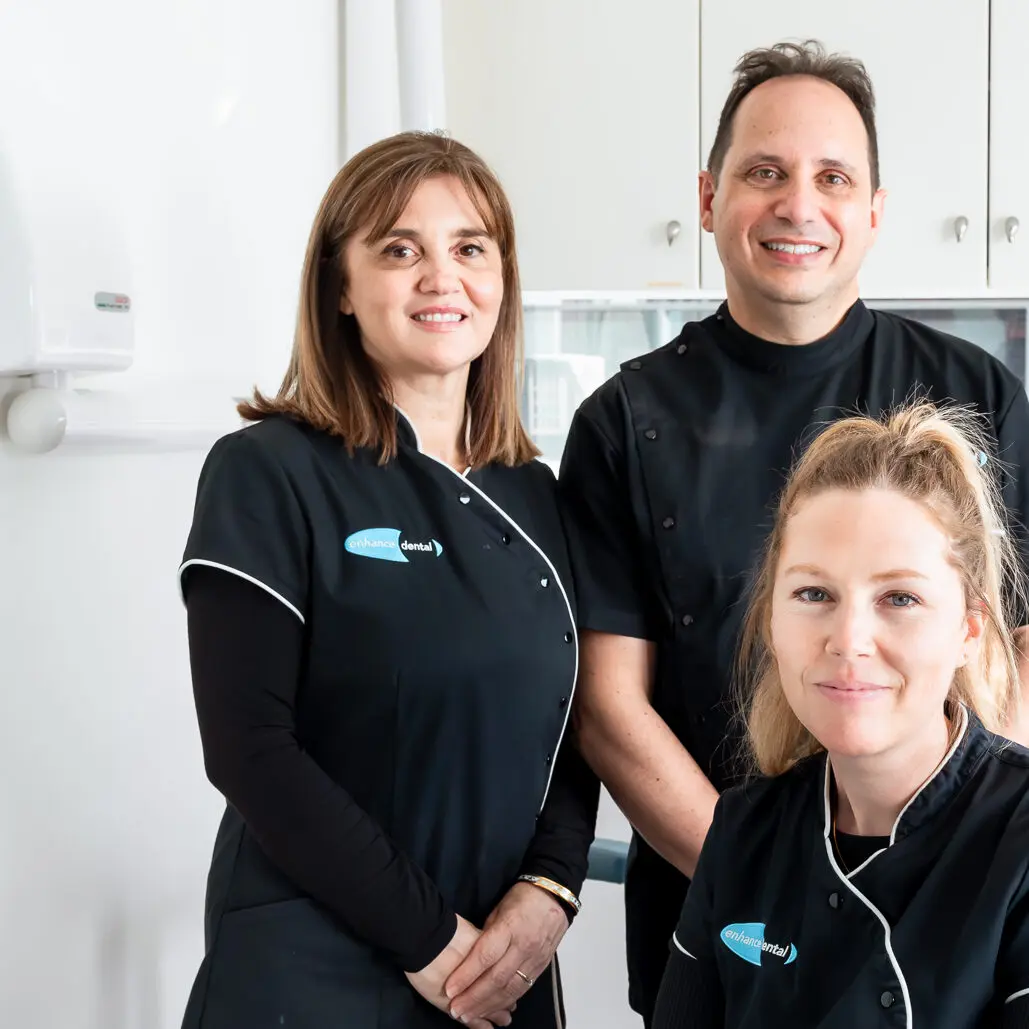
Meet Dr Paino and the team

Take the next step at your pace
Let’s plan your extraction—and what comes next
Whether your priority is relief from pain, a temporary front tooth or understanding your options, our team can help you arrange an assessment.
Enhance Dental · Level 2, Suite 219, 566 St Kilda Road, Melbourne VIC 3004
Directions, contact details and enquiry form
Any surgical or invasive procedure carries risks. Before proceeding, you should seek a second opinion from an appropriately qualified health practitioner.