
Enhance Dental · St Kilda Road, Melbourne
Root Canal Treatment Melbourne
Relieve the infection. Keep your natural tooth when it can be saved.
Toothache can make everything else feel secondary. We’ll listen, explain what the tests show and help you choose a comfortable plan for your tooth.
Treatment is planned individually after an examination. A root canal is one option when the tooth is restorable.
Understanding the problem
Why might I need root canal treatment?
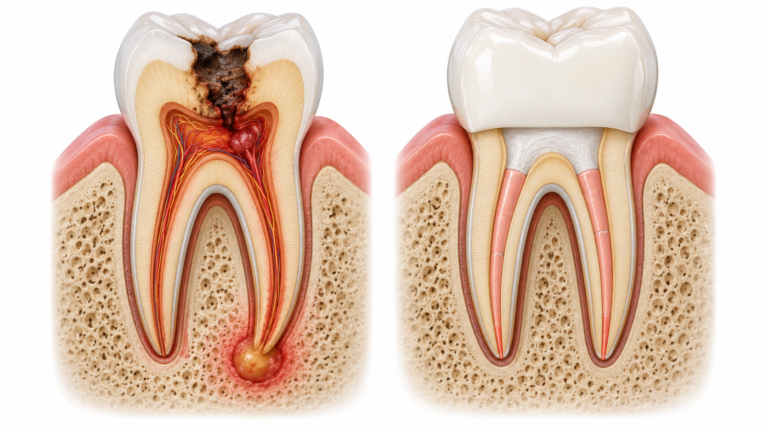
The pulp is the soft tissue in the centre of a tooth. It contains nerves and blood vessels. Deep decay, a crack, an injury, a large or repeated filling, or severe wear can inflame or infect it. Sometimes the pulp dies without much warning.
A darkening tooth, gum pimple, tenderness when biting, lingering hot or cold sensitivity, spontaneous toothache or swelling can be clues. Some teeth have few or no symptoms. When the pulp is irreversibly inflamed or infected, root canal treatment may help keep a restorable tooth.
Your dentist considers your history, examination, tests of the tooth and surrounding tissues, and appropriate dental images. A shadow near a root tip may show inflammation in surrounding bone; it is interpreted alongside the other findings.
A calmer appointment
How we make treatment more comfortable
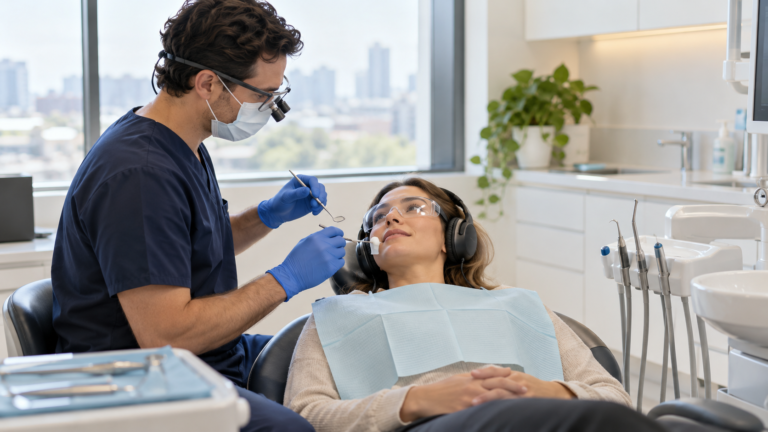
It can feel daunting to sit in the chair when a tooth has been painful. We’ll ask what helps you feel safe, explain what is happening and agree on a hand signal so you can request a pause.
Small details can make a difference
- Local anaesthetic: we allow time to check numbness. Numbing cream can be applied before an injection; a computer-controlled system such as CALAJECT may be used when appropriate.
- Pain relief planning: we can discuss suitable pain relievers before or after treatment. Using more than one type is sometimes appropriate, depending on your health, medicines and allergies.
- Distractions and comfort: choose music or Netflix with headphones; we can offer extra cushions, lip balm and brief breaks.
- Jaw support: a bite support or bite block can reduce the effort of holding your mouth open. We can adjust it or pause if your jaw is tired.
- Rubber dam: this isolates the tooth and helps keep the area dry and protect your mouth from small instruments and rinsing solutions.
Everyone responds differently. A very inflamed tooth can be harder to numb, and treatment is not guaranteed to be completely painless. If you feel discomfort, tell us so we can stop, reassess and discuss the next step.
What to expect
Root canal treatment, step by step
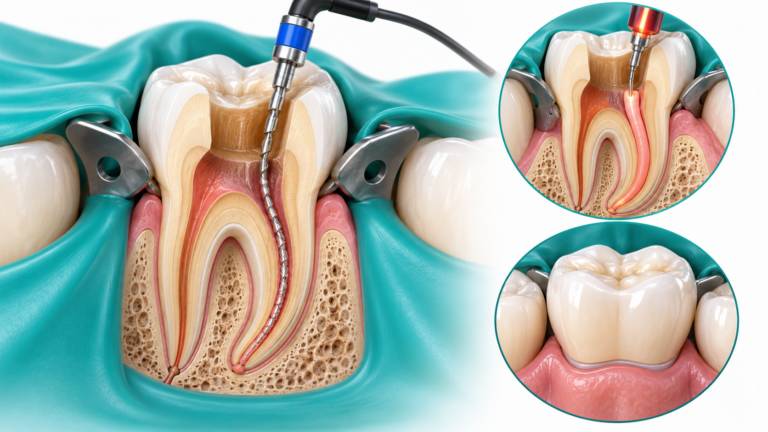
Some teeth can be treated in one visit; others need more than one appointment. The sequence depends on the tooth, its anatomy, infection and response.
Assess and numb
We examine the tooth, discuss the findings and options, then use local anaesthetic and check comfort.
Isolate and access
A rubber dam isolates the tooth. A small opening gives access to the pulp chamber and canals.
Clean and seal
The diseased pulp is removed. The canals are cleaned, shaped, disinfected, filled and sealed.
Restore and review
A temporary or definitive restoration is placed. We plan suitable protection and follow-up.
A tooth can be tender for a short time afterwards, especially if it was sore before treatment. Contact us if pain or swelling is increasing or not settling as expected.
Precision and planning
Digital working-length measurement
We use a Seedent RPEX 6 electronic apex locator to help estimate the working length of each root canal.

A fine file in the canal works with the device’s electronic measurements to help identify the canal end. This can reduce the need for some additional X-rays taken specifically to check canal length.
The apex locator is a measuring aid, not a substitute for clinical judgement or every dental X-ray. Used alongside appropriate digital radiographs, it helps check working length. Research finds electronic measurements and radiographs are complementary; accuracy can vary with anatomy and clinical conditions.
How we fill the canals
After cleaning and shaping, canals need to be sealed. In suitable cases, I use a carrier-based warm gutta-percha method such as Thermafil or Soft-Core. The gutta-percha is gently heated and carried into the prepared canal. In my experience, this can make the filling stage efficient, while the warm material adapts to the canal space and its irregularities.
No filling method suits every tooth. Long-term results depend on diagnosis, cleaning and disinfection, a suitable seal and a well-fitting final restoration—not one product alone.
Long-term protection
After the root canal: protect the tooth
Root canal treatment removes the pulp; it does not replace tooth structure already lost to decay, cracks or previous fillings. Back teeth also take substantial chewing forces.
For these reasons, cuspal coverage is often advised for a root-treated molar or premolar. Depending on the remaining tooth and your bite, this may be a full crown—often zirconia or another suitable ceramic—or a bonded ceramic or porcelain overlay when a more conservative cuspal-coverage restoration is appropriate. A suitable direct white restoration may be enough for some teeth.
Leaving a structurally weakened back tooth without suitable cuspal coverage can increase the risk of fracture and failure. We’ll explain the options and timing after checking how much sound tooth remains.
Outcomes and follow-up
Success, healing and possible failure
As a practical guide, around 1 in 10 teeth may not heal as hoped or may need further care, but estimates vary with the tooth, starting condition and how success is defined. A 2022 systematic review reported pooled success estimates of about 92.6% when reduction in an existing root-tip lesion counted as success, and about 82% when complete radiographic resolution was required. These study averages are not a prediction for an individual tooth.
A root canal can fail because of complex or missed anatomy, a crack, a leaking restoration, reinfection or other factors. Further options may include monitoring, re-treatment, endodontic surgery, referral to an endodontist or extraction. For complex cases, we mostly refer to Endodontic Associates in central Melbourne. We’ll review your symptoms and images, explain the findings and coordinate the next steps with you.
Urgent symptoms
Antibiotics and a dental abscess
Antibiotics are not routinely needed for toothache or a localised abscess, and they do not remove the source of infection inside a tooth. Definitive dental treatment—such as root canal treatment, drainage or extraction—is usually needed.
A dentist may prescribe antibiotics when infection is spreading, causing systemic illness or when your medical circumstances make them appropriate. This decision follows an assessment; do not take leftover antibiotics.
Your choices
Alternatives to root canal treatment
We’ll discuss the benefits, limits, costs and risks of the choices that fit your tooth and preferences.
Monitor or delay
Only where your dentist considers it reasonable. An inflamed or infected tooth can worsen, and delay may reduce later options.
Extraction
Removes the tooth and infection source when it cannot or should not be saved. You may leave the space or discuss replacement.
Partial denture
A removable partial denture, including a Valplast-style denture, may suit some teeth, gums, bites and preferences.
Bridge
A Maryland bridge or conventional bridge, including zirconia, can suit selected cases. Neighbouring teeth and your bite need consideration.
Dental implant
An implant may be considered after thorough assessment of your health, gums, bite and bone. CBCT is used when clinically indicated for planning.
Orthodontic space closure
Braces or Invisalign may be considered in selected cases when tooth movement and your overall bite make this a suitable plan.
If a root canal fails and you do not want, or are not suitable for, re-treatment, we can discuss these options again. Read more about tooth extraction, dentures, Discover Porcelain Bridges, Explore Dental Implants and Invisalign.
Answers to common questions
Root canal treatment: FAQs
Select a question to open its answer.
Will root canal treatment hurt?
Local anaesthetic is used to numb the treatment area, and we use additional comfort measures where appropriate. A very inflamed tooth can be harder to numb and some tenderness afterwards is possible. We cannot promise treatment will be completely painless, but we’ll listen, pause and adjust the plan if you feel discomfort.
How do you know whether I need a root canal?
We combine your symptoms and dental history with an examination, pulp tests, bite or percussion tests where appropriate, and dental radiographs. No single symptom or X-ray always gives the answer on its own.
How long does treatment take, and how many visits will I need?
It depends on the tooth, the number and shape of its canals, infection and whether the case is straightforward or complex. Some cases need one appointment and others need more. We’ll estimate the sequence after assessing your tooth.
Will I need a crown after root canal treatment?
Not every tooth needs the same restoration. Back teeth with substantial loss of structure often benefit from a crown or adhesive overlay that covers and protects the cusps. We’ll recommend a restoration after checking the remaining sound tooth and your bite.
Can antibiotics make a tooth abscess go away?
Antibiotics may be appropriate if infection is spreading or causing systemic symptoms, but they do not remove infected pulp inside the tooth. Dental treatment is usually needed to address the source. Facial swelling needs prompt dental advice; breathing or swallowing difficulty is an emergency.
What can I do if I choose not to have root canal treatment?
Depending on the diagnosis, monitoring may be possible for a time, or extraction may be advised. If the tooth is removed, options can include a partial or Valplast denture, Maryland or conventional zirconia bridge, implant after assessment, or orthodontic space closure with braces or Invisalign when suitable. We’ll explain the consequences and alternatives.
What happens if root canal treatment does not work?
We assess symptoms and follow-up images. Further care might include re-treatment, referral to an endodontist, endodontic surgery or extraction. The right option depends on the cause and whether the tooth can be restored.
A friendly next step
Let’s find out what your tooth needs
If you have toothache, lingering sensitivity, a cracked tooth or swelling, contact our team for an assessment. We’ll listen, explain what we find and give you time to consider your options.

Evidence and further reading
Clinical references
- European Society of Endodontology S3 clinical practice guideline for pulpal and apical disease (2023).
- Systematic review of primary root canal treatment outcomes (Burns et al., 2022).
- Systematic review and meta-analysis of electronic apex locators compared with radiographs.
- Systematic review of crowns and cuspal-coverage onlays for endodontically treated teeth.
- healthdirect: tooth abscesses and when to seek care.
Any surgical or invasive procedure carries risks. Seek a second opinion from an appropriately qualified health practitioner if you wish. This general information does not replace an examination, diagnosis or personalised advice.